Modern search is changing quickly. Traditional SEO is no longer enough for websites that want visibility in AI-powered search engines, voice assistants, and answer engines.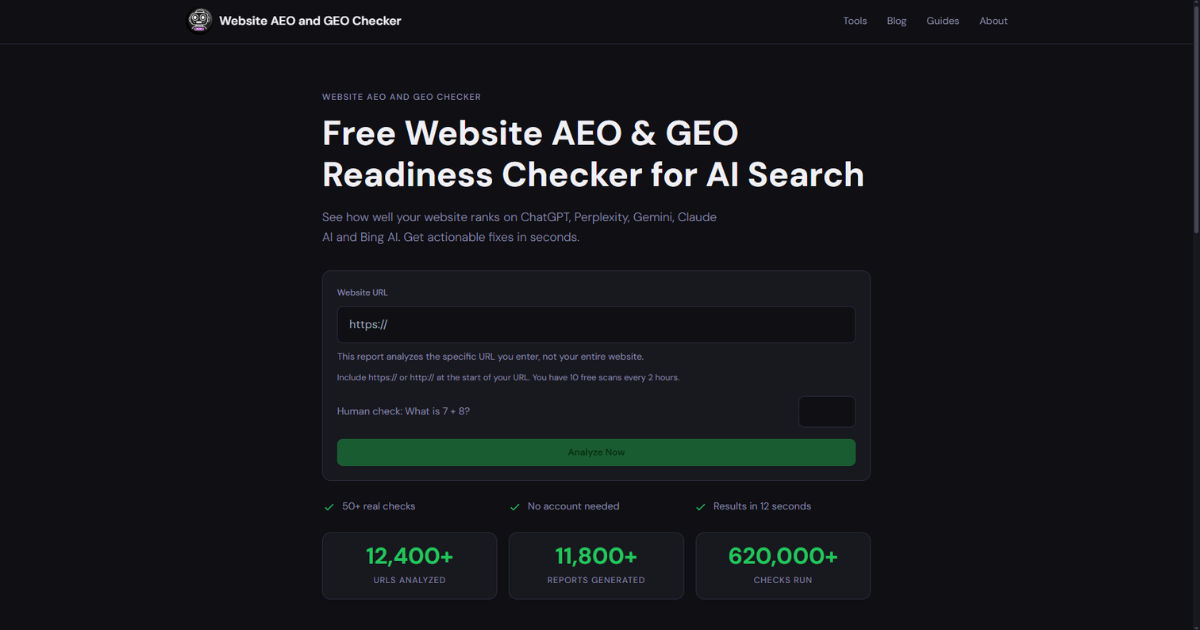
Businesses, bloggers, marketers, and publishers now need to understand how Answer Engine Optimization works and how to create content that directly answers user questions.
One of the most important tools helping website owners improve this process is the “Website AEO and GEO Checker.” This tool helps analyze how well your pages are optimized for AI-generated answers, featured snippets, and geographic relevance.
As AI search becomes more advanced, using a Website AEO and GEO Checker can help websites improve content quality, visibility, and trustworthiness.But many beginners still ask an important question: how should website AEO answers be written?
The answer is simple. AEO content must be clear, direct, structured, conversational, factual, and easy for both humans and AI systems to understand. Unlike old-style SEO articles that focused mostly on keywords, AEO writing focuses on answering user intent quickly and accurately.
This complete guide explains how website AEO answers should be written, why structure matters, and how tools like a Website AEO and GEO Checker can improve performance.
Website AEO
Website AEO stands for Answer Engine Optimization. It is the process of optimizing website content so AI systems, voice assistants, search engines, and chatbots can easily understand and deliver answers from your pages.
Instead of only ranking pages in search results, AEO helps websites become direct answer sources.
Examples include:
- Google featured snippets
- AI Overviews
- Voice search answers
- Chatbot responses
- Smart assistant replies
- Zero-click search results
When people ask questions online, answer engines look for concise and reliable information. A Website AEO and GEO Checker helps determine whether your content meets these standards.
Why AEO Writing Is Different From Traditional SEO Writing
Traditional SEO writing often focused heavily on keywords and backlinks. AEO writing focuses more on clarity, relevance, and answer quality.
Here are the biggest differences.
| Traditional SEO | AEO Writing |
|---|---|
| Focus on rankings | Focus on answers |
| Long keyword stuffing | Natural language |
| Broad content | Direct responses |
| Search engine crawlers | AI understanding |
| Link-heavy | Intent-focused |
| Large paragraphs | Short readable sections |
A Website AEO and GEO Checker helps identify whether your content follows modern AEO best practices instead of outdated SEO methods.
Why Clear Answers Matter in AEO
AI systems prefer content that gives immediate value. Long introductions and filler content often reduce answer quality.
Good AEO answers should:
- Solve the user’s question quickly
- Use simple language
- Avoid confusion
- Include supporting details
- Remain factually accurate
- Be easy to scan
When using a Website AEO and GEO Checker, one major factor analyzed is answer clarity.
For example:
Bad answer:
“Digital marketing has evolved over the years with multiple strategies businesses can use for visibility.”
Better AEO answer:
“Digital marketing is the use of online channels like search engines, social media, and email to promote products or services.”
The second example is clearer and easier for AI systems to extract.
Start With the User Question
The best AEO content starts by understanding user intent.
Ask yourself:
- What is the user really asking?
- What exact answer do they need?
- How quickly can the answer be delivered?
A Website AEO and GEO Checker often evaluates whether content properly targets search intent.
For example:
User question:
“How should website AEO answers be written?”
Strong AEO answer:
“Website AEO answers should be written clearly, directly, and conversationally while focusing on user intent and structured formatting.”
The answer appears immediately without unnecessary information.
Use Conversational Language
Modern AI search engines prefer natural language because people search conversationally.
Instead of robotic writing, content should sound human.
Poor example:
“Website optimization procedures facilitate informational retrieval.”
Better example:
“Website optimization helps users and search engines find answers faster.”
A Website AEO and GEO Checker can help identify overly complex language that may reduce answer effectiveness.
Keep Sentences Short and Clear
Short sentences improve readability for both humans and AI systems.
Good AEO writing avoids:
- Overly technical language
- Long paragraphs
- Complicated grammar
- Confusing explanations
Instead, use:
- Simple sentence structures
- Clear transitions
- Direct explanations
- Everyday vocabulary
Example:
Weak:
“The implementation of structured optimization methodologies contributes substantially toward enhanced visibility metrics.”
Strong:
“Structured optimization improves online visibility.”
Simple writing performs better in AEO systems.
Use Proper Heading Structure
Headings help AI understand page organization.
Good heading structure improves:
- Readability
- Crawling
- Featured snippet selection
- Voice search extraction
A Website AEO and GEO Checker often analyzes heading hierarchy for optimization quality.
Good structure:
- Main topic
- Supporting sections
- Specific subtopics
- FAQs
This makes information easier to understand and extract.
Answer Questions Early
One of the most important AEO strategies is placing answers near the beginning of sections.
Do not force users to scroll through unnecessary content.
Example:
Question:
“What is AEO?”
Bad structure:
Several paragraphs before answering.
Good structure:
“AEO stands for Answer Engine Optimization. It helps websites become trusted answer sources for AI search engines and voice assistants.”
Direct answers improve AI extraction potential.
Use FAQ Sections
FAQ sections are extremely valuable for AEO.
Why?
Because AI systems often pull answers directly from question-and-answer formats.
Good FAQ sections include:
- Real search questions
- Concise answers
- Clear formatting
- Natural wording
A Website AEO and GEO Checker can identify whether FAQ formatting supports AI visibility.
Example:
What is Website AEO?
Website AEO is the process of optimizing content so answer engines and AI systems can easily understand and display responses from a webpage.
Optimize for Voice Search
Voice searches are usually conversational and question-based.
Examples:
- “How does AEO work?”
- “What is answer engine optimization?”
- “Why is AEO important?”
Voice-friendly content should:
- Use natural speech patterns
- Include concise answers
- Avoid complicated wording
- Match spoken questions
A Website AEO and GEO Checker helps analyze voice-search readiness.
Use Structured Data
Structured data helps search engines understand page content.
Important schema types include:
- FAQ schema
- Article schema
- Local business schema
- How-to schema
- Review schema
Structured data improves the chances of:
- Featured snippets
- Rich results
- AI answer visibility
Many Website AEO and GEO Checker tools analyze schema implementation.
Focus on Entity-Based Writing
Modern AI search systems understand entities more than simple keywords.
Entities include:
- People
- Brands
- Places
- Products
- Topics
Instead of repeating keywords unnaturally, use context-rich writing.
Example:
Weak:
“SEO tools improve SEO performance with SEO strategies.”
Strong:
“SEO tools help businesses improve rankings, analyze traffic, and optimize content.”
Natural language improves semantic understanding.
Build Trust With Accurate Information
Trust is critical for AEO success.
AI systems prioritize reliable content.
Good AEO answers should include:
- Accurate facts
- Updated information
- Credible references
- Consistent explanations
- Expert insights
A Website AEO and GEO Checker can help identify trust and authority issues in content.
Avoid Keyword Stuffing
Keyword stuffing damages readability and reduces trust.
Instead of forcing keywords repeatedly, integrate them naturally.
For example, the phrase “Website AEO and GEO Checker” should appear naturally inside meaningful sentences.
Good example:
“A Website AEO and GEO Checker helps website owners improve answer visibility and geographic optimization.”
Bad example:
“Website AEO and GEO Checker improves Website AEO and GEO Checker optimization using Website AEO and GEO Checker systems.”
Natural integration matters more than repetition.
Write for Featured Snippets
Featured snippets often pull short answer blocks from webpages.
To optimize for snippets:
- Use concise definitions
- Add bullet points
- Include numbered lists
- Use clear formatting
- Answer questions directly
Example:
How can websites improve AEO?
Websites can improve AEO by:
- Writing direct answers
- Using structured headings
- Adding FAQ sections
- Improving readability
- Using schema markup
This format works well for snippets and AI extraction.
Use Lists and Bullet Points
AI systems prefer organized information.
Lists improve:
- Readability
- Extraction
- User experience
- Scannability
A Website AEO and GEO Checker often measures formatting quality.
Use bullet points for:
- Features
- Benefits
- Steps
- Comparisons
- Best practices
Make Content Easy to Scan
Most users skim content quickly.
AEO writing should include:
- Short paragraphs
- Subheadings
- White space
- Lists
- Highlighted points
Dense blocks of text reduce engagement.
Simple formatting improves retention and AI readability.
Add Geographic Relevance
GEO optimization is becoming increasingly important.
GEO stands for Geographic Engine Optimization.
AI systems often personalize results based on location.
A Website AEO and GEO Checker helps websites analyze local optimization strength.
Ways to improve GEO optimization:
- Mention target locations naturally
- Add local keywords
- Use local schema
- Create regional landing pages
- Include localized FAQs
Example:
“Best digital marketing agency in New York.”
Geographic relevance helps local visibility.
Improve Content Freshness
Outdated information reduces trust.
AI systems favor updated content.
To maintain freshness:
- Update statistics regularly
- Refresh examples
- Revise outdated advice
- Add recent trends
- Improve old sections
A Website AEO and GEO Checker can help identify stale content areas.
Use Semantic SEO Principles
Semantic SEO helps search engines understand meaning and relationships.
Instead of focusing only on one keyword, include related concepts.
For AEO articles about answer engines, include related terms like:
- AI search
- Voice search
- Featured snippets
- Conversational queries
- Structured data
- Search intent
This creates topic depth.
Create Helpful and Original Content
AI systems increasingly prioritize originality.
Avoid:
- Thin content
- Generic explanations
- Duplicate pages
- AI spam writing
- Repetitive filler
Instead:
- Add real insights
- Use examples
- Explain concepts clearly
- Share practical advice
- Offer unique perspectives
A Website AEO and GEO Checker can help evaluate overall content quality.
Improve Readability Scores
Readable content performs better for both users and AI systems.
Good readability practices include:
- Short sentences
- Simple words
- Active voice
- Clear structure
- Easy transitions
Aim for content understandable by a broad audience.
Use Question-Based Headings
Question headings match search behavior.
Examples:
- What is AEO?
- Why does AEO matter?
- How can websites improve AEO?
- What makes good AEO content?
These headings help AI connect content with search queries.
A Website AEO and GEO Checker can help determine whether question targeting is effective.
Include Definitions Early
Definitions are highly valuable in AEO.
AI systems frequently extract concise definitions.
Good definition example:
“AEO is the process of optimizing content for AI-powered answer engines.”
Keep definitions:
- Short
- Clear
- Accurate
- Direct
Balance Humans and AI
AEO content should never sound robotic.
Write for people first.
Then optimize for AI readability.
Good balance includes:
- Natural tone
- Helpful explanations
- Structured formatting
- Clear answers
- Human readability
The best AEO content feels conversational while remaining informative.
Understand Search Intent Types
Different queries require different answer styles.
Informational Intent
Users want information.
Example:
“What is AEO?”
Best response:
Clear explanation.
Navigational Intent
Users seek a specific site.
Example:
“Best AEO tools.”
Best response:
Tool recommendations.
Transactional Intent
Users want to buy or subscribe.
Example:
“Buy AEO software.”
Best response:
Product-focused content.
A Website AEO and GEO Checker helps evaluate intent alignment.
Optimize Meta Descriptions
Meta descriptions still matter.
Good meta descriptions should:
- Summarize clearly
- Include primary keywords
- Encourage clicks
- Match page content
Example:
“Learn how website AEO answers should be written for AI search, voice search, and featured snippets using practical optimization strategies.”
Improve Page Experience
User experience affects AEO success.
Important factors include:
- Mobile responsiveness
- Fast loading speed
- Clean design
- Easy navigation
- Accessible formatting
Poor user experience reduces engagement signals.
Use Examples Throughout Content
Examples improve understanding.
Instead of only explaining theories, show practical applications.
Example:
Weak explanation:
“AEO improves AI visibility.”
Better explanation:
“If someone asks a voice assistant a question, properly optimized AEO content increases the chance your answer will be spoken aloud.”
Practical examples help readers learn faster.
Avoid Overcomplicated Technical Terms
Many readers are beginners.
Use technical terms only when necessary.
When using technical language:
- Explain definitions
- Use examples
- Simplify concepts
AEO writing should feel approachable.
Use Internal Linking
Internal links help AI understand content relationships.
Good internal linking:
- Improves navigation
- Builds topic authority
- Helps crawling
- Increases engagement
Link related topics naturally within articles.
Measure Performance Regularly
AEO optimization is ongoing.
Track performance using:
- Search visibility
- Featured snippets
- Voice search results
- User engagement
- Click-through rates
A Website AEO and GEO Checker provides valuable optimization insights.
Common Mistakes in AEO Writing
Many websites make avoidable mistakes.
Writing Long Introductions
Users want answers quickly.
Ignoring Search Intent
Content must match the user’s question.
Keyword Stuffing
Overusing keywords harms readability.
Weak Formatting
Poor structure reduces AI understanding.
Thin Content
Shallow articles provide little value.
No FAQ Sections
FAQs improve answer extraction.
Overusing Jargon
Complicated writing confuses readers.
Avoiding these mistakes improves performance significantly.
Future of AEO Writing
The future of search is AI-driven.
As AI assistants become more advanced, answer-focused content will become even more important.
Future trends include:
- Conversational AI search
- Personalized answers
- Voice-first experiences
- AI-generated summaries
- Semantic understanding
- Geographic personalization
A Website AEO and GEO Checker will likely become essential for digital publishers wanting strong visibility.
Best Practices Summary
Here are the most important AEO writing principles.
Write Direct Answers
Answer questions quickly and clearly.
Use Natural Language
Write conversationally.
Structure Content Properly
Use headings, lists, and short paragraphs.
Focus on User Intent
Understand what users truly need.
Add FAQ Sections
Question-answer formats improve visibility.
Optimize for Voice Search
Use spoken-style language.
Build Trust
Provide accurate and updated information.
Improve GEO Optimization
Include geographic relevance naturally.
Use Tools
A Website AEO and GEO Checker helps identify optimization opportunities.
Conclusion
Website AEO is transforming how content is created and discovered online. Traditional SEO alone is no longer enough in a world dominated by AI-powered search engines, voice assistants, and direct answer systems. Websites now need content that is structured, conversational, accurate, and easy for machines to understand.
The key to writing strong AEO answers is simplicity. Content should directly answer questions, use natural language, maintain clear formatting, and prioritize user intent. Short paragraphs, question-based headings, FAQ sections, and structured information all improve answer visibility.
At the same time, GEO optimization is becoming increasingly important because AI systems personalize answers based on user location. This is where tools like a Website AEO and GEO Checker become extremely valuable. They help website owners analyze readability, answer structure, geographic targeting, and AI optimization quality.
Businesses, bloggers, marketers, and publishers who adapt early to AEO strategies will have a stronger advantage in future search ecosystems. By focusing on helpful answers instead of outdated keyword stuffing, websites can improve visibility, trust, and user engagement.
The future of search belongs to websites that provide clear, valuable, and accessible answers. Learning how website AEO answers should be written is one of the most important steps toward long-term digital success.