Learning new words can be challenging, especially when students encounter unfamiliar vocabulary in a second language. Bilingual vocabulary cards offer a simple way to connect a new word with a familiar language, making it easier to understand and remember. Instead of memorizing isolated definitions, learners can see a word, its meaning, and sometimes an example sentence together.
Word recall is more than recognizing a word when you see it. It means being able to retrieve that word from memory when you need to speak or write. This distinction makes effective vocabulary practice important for students who want to build stronger language skills.
What Are Bilingual Vocabulary Cards?
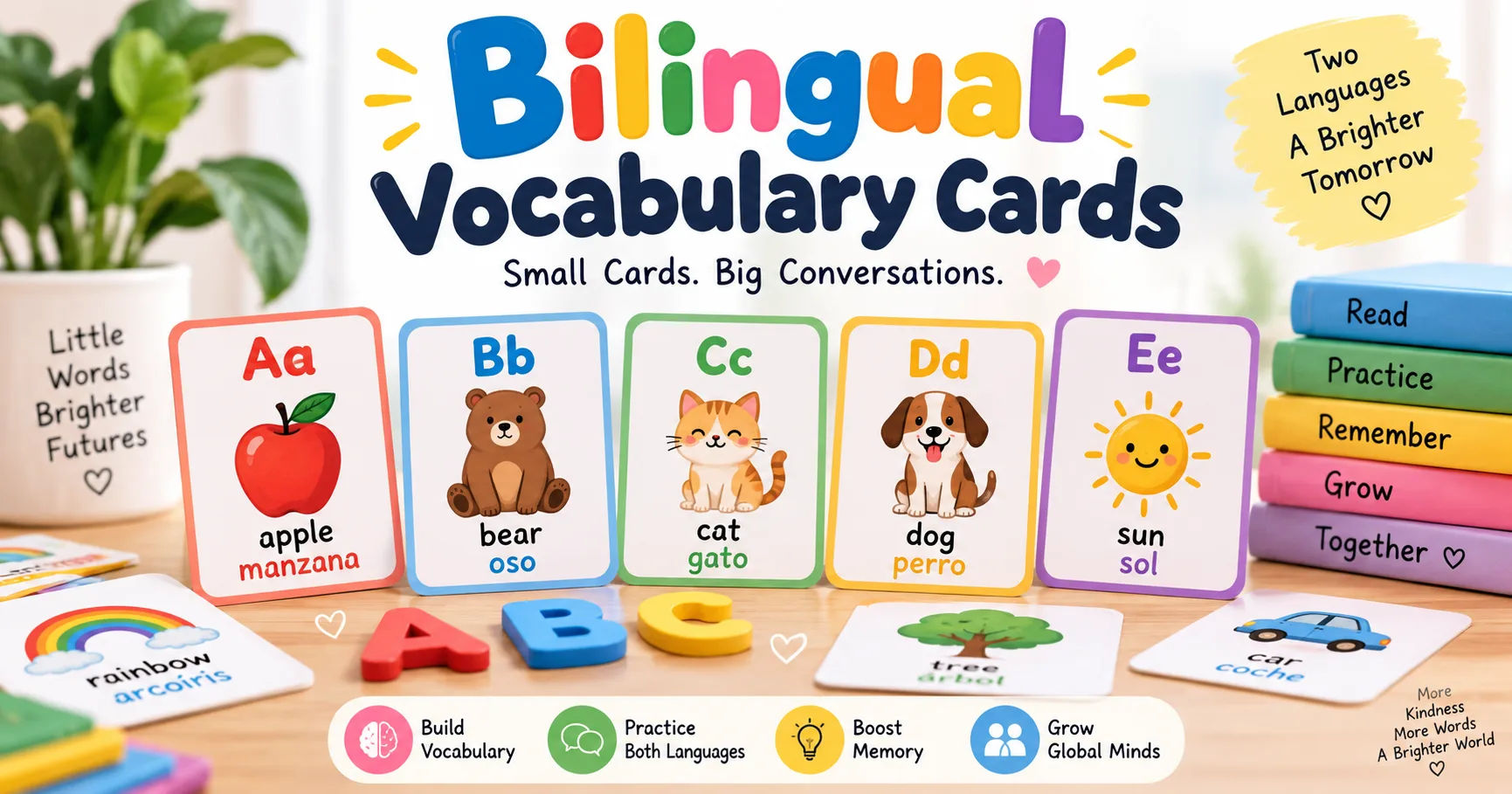
Bilingual vocabulary cards are learning cards that present vocabulary in two languages. One side may contain a new word in the language being learned, while the other side provides its translation in the learner's familiar language.
For example, an English learner might see the word “beautiful” on one side and “خوبصورت” on the other. A card can also include pronunciation, an example sentence, an image, or related words.
The basic idea is straightforward: learners repeatedly connect the unfamiliar word with a meaning they already understand.
How Do They Differ From Regular Flashcards?
Traditional flashcards can contain a word and its definition in the same language. Bilingual cards instead create a bridge between two languages.
This can be especially useful at earlier stages of language learning. A student does not always have enough vocabulary to understand a complicated definition written entirely in the target language.
A direct translation can provide immediate access to meaning. Over time, however, learners should also practice understanding and using the target word without depending entirely on translation.
How Does Word Recall Work?
Memory involves several processes. When a learner first encounters a word, the brain needs to notice it and connect it with meaning. With repeated exposure and active practice, that information can become easier to retrieve.
Word recall happens when the learner produces the vocabulary item from memory rather than simply recognizing it.
For example, recognizing “generous” on a vocabulary list is different from remembering the word when trying to describe a generous person. The second task requires stronger retrieval.
Recognition vs. Recall
Recognition asks, “Have I seen this before?”
Recall asks, “What is the word I need?”
This difference matters because learners can sometimes feel that they know a vocabulary item simply because it looks familiar. A flashcard exercise that requires the learner to produce the answer can provide more meaningful retrieval practice.
Bilingual vocabulary cards can support both forms of learning, depending on how they are used.
Why Bilingual Cards May Support Recall
One possible advantage of bilingual learning cards is that they provide a clear association between two pieces of information.
A learner may already know the concept in their first language. Connecting that known concept to a new word gives the unfamiliar vocabulary an existing mental reference point.
For example, someone who already understands the idea of “freedom” can connect that concept to the English word “liberty.” The familiar meaning provides a starting point for remembering the new term.
They Provide Immediate Meaning
A learner can quickly understand what a new word means without searching through a long dictionary definition.
This reduces unnecessary confusion during early learning. When the meaning is clear, the learner can spend more time practicing pronunciation, spelling, and retrieval.
Immediate understanding can also make study sessions more efficient.
They Create Associations
Memory often becomes stronger when information is connected to something meaningful.
A bilingual card connects the target-language word with a familiar translation. If additional information is included, the learner may create even more associations.
For instance, a card for “journey” could include its translation, pronunciation, and a sentence such as “The journey took three hours.”
The learner is then remembering more than a single isolated word.
The Importance of Active Recall
One of the strongest ways to use vocabulary cards is through active recall.
Instead of looking at both sides immediately, the learner should first try to remember the answer.
Suppose the front of the card says “ancient.” The learner should pause and ask, “What does this mean?” Only after making an attempt should they check the other side.
This process forces the brain to retrieve information.
Why Retrieval Practice Matters
Every successful retrieval gives the learner practice accessing stored information.
Even an unsuccessful attempt can be useful because it identifies a word that needs more attention.
For this reason, simply reading bilingual cards repeatedly may not be as effective as testing yourself with them.
A productive session should involve looking at one side, covering the answer, making a genuine attempt, and then checking the result.
Spaced Practice Can Make Cards More Effective
The timing of vocabulary practice also matters.
Studying the same words continuously in one sitting can make them feel familiar, but that familiarity may disappear later. Spacing study sessions across several days gives learners repeated opportunities to retrieve words after some forgetting has occurred.
Bilingual vocabulary cards can easily be used with this approach.
A learner might review difficult words every day while reviewing easier words less frequently. Digital flashcard applications can automate this process, while physical cards can be organized into different review groups.
A Simple Spaced-Review Routine
A student could introduce ten new words on Monday.
On Tuesday, the student reviews those words and separates them into words they remembered and words they forgot. The difficult cards receive additional practice.
The same process can continue later in the week. After several sessions, words that were initially difficult may become easier to retrieve.
The exact schedule does not need to be complicated. Consistent review is more important than creating an elaborate system that is difficult to maintain.
How to Design Better Bilingual Vocabulary Cards
The quality of a card can affect how useful it is.
A card should contain enough information to make the word understandable but should not become so crowded that studying it feels overwhelming.
Include the Target Word Clearly
The vocabulary item should be easy to see.
Avoid placing several unrelated words on the same card. Each card should generally focus on one vocabulary item or one closely connected concept.
Add a Natural Translation
The translation should communicate the intended meaning in context.
Some words have several meanings, so a single translation may not always be sufficient. If a word can be used in different ways, an example sentence can clarify the intended meaning.
Use Example Sentences
Example sentences show learners how vocabulary works in real communication.
For example:
Target word: “predict”
Meaning: “to say what you think will happen”
Example: “Scientists predict that the weather will change tomorrow.”
The sentence helps connect the word with an actual situation.
Add Pronunciation When Needed
Pronunciation information can be useful, particularly for words that are difficult to say or do not sound the way they appear.
Hearing the word aloud can also create another memory connection.
Should Learners Always Use Translations?
Not necessarily.
Translations can be very helpful, particularly when introducing unfamiliar vocabulary. However, advanced learners may benefit from gradually reducing their dependence on their first language.
For example, a beginner might use:
English: “rapid”
Translation: “تیز / بہت تیز”
Later, the learner might use an English definition:
Rapid: happening very quickly.
Eventually, the learner should be able to understand and use “rapid” naturally in an English sentence without mentally translating it first.
Moving From Translation to Context
A useful long-term strategy is to use bilingual support when necessary while increasing exposure to target-language explanations and examples.
This allows the first language to act as a bridge rather than a permanent dependency.
Common Mistakes When Using Vocabulary Cards
Vocabulary cards are simple, but ineffective study habits can reduce their value.
One common mistake is reading the answer before attempting to remember it. This creates recognition without giving the learner enough retrieval practice.
Another mistake is trying to memorize too many words at once.
Students may also focus only on translations and ignore pronunciation, spelling, grammar, and actual usage.
Memorizing Without Using the Word
Knowing a translation does not automatically mean knowing how to use a word.
A student may remember that “accurate” means “correct” but still struggle to use it naturally in conversation.
After learning a word, learners should try creating their own sentence. They can also use the word in a short paragraph, discussion, or writing exercise.
Can Images Improve Vocabulary Recall?
Images can provide another memory connection.
A concrete word such as “mountain” is easy to visualize. A picture of a mountain can reinforce the association between the target word and the concept.
Abstract vocabulary can be more difficult, but diagrams, situations, or short examples can still provide useful context.
The goal is not to decorate every card. The goal is to provide information that makes the word easier to understand and retrieve.
Who Can Benefit From Bilingual Vocabulary Cards?
These cards can be useful for many types of learners.
Students learning a foreign language can use them to build everyday vocabulary. School students can use them to prepare for language exams. Adults learning another language for work or travel can use them to practice practical terms.
They can also help learners who feel overwhelmed by monolingual dictionaries or explanations.
Beginners
Beginners often benefit from direct connections between familiar meanings and unfamiliar words.
Bilingual cards can reduce the amount of time spent trying to understand a definition that contains several other unknown words.
Intermediate Learners
Intermediate learners can use cards to expand vocabulary while focusing more heavily on context and sentence production.
At this stage, cards can include synonyms, collocations, example sentences, and grammatical information.
Advanced Learners
Advanced students can use bilingual cards selectively for specialized or less common vocabulary.
They may benefit more from target-language definitions, authentic examples, and subject-specific contexts while keeping translations available for difficult concepts.
How to Use Cards for Better Long-Term Recall
A balanced study routine can combine several activities.
Start by learning a small group of words. Test yourself instead of simply reading the cards. Mark difficult words and review them more frequently.
Then create sentences using the words.
Later, try recalling the target word from its meaning and recalling its meaning from the target word. Switching directions makes the learner retrieve information in different ways.
Reading and conversation should also be part of the process. Vocabulary becomes more useful when learners encounter and produce words in realistic situations.
Bilingual Cards and Digital Learning
Digital flashcard tools can make vocabulary practice convenient.
Students can study on a computer or phone and often organize vocabulary into different sets. Some systems can also schedule reviews based on previous performance.
Physical cards still have advantages. Writing a card by hand may encourage deeper attention, and some students find physical study materials less distracting.
The best format depends on the learner's habits and consistency.
Measuring Whether Recall Is Improving
Learners can test themselves periodically.
Instead of asking whether a word “looks familiar,” they can write down as many target-language words as they remember from a group of meanings.
Another useful test is sentence completion.
For example:
“The scientist used several methods to ______ the results.”
If the learner can retrieve “predict,” “analyze,” or another appropriate word depending on the original vocabulary set, they are practicing active production rather than simple recognition.
Keeping track of difficult words can also show which vocabulary items require additional practice.
Conclusion
Bilingual vocabulary cards can be a useful tool for improving word recall when they are combined with active retrieval, spaced practice, meaningful examples, and regular language use. Their biggest advantage is the clear connection they create between an unfamiliar word and a meaning the learner already understands.
However, cards are not a complete language-learning system by themselves. Memorizing translations is only one part of vocabulary development. Learners also need to understand pronunciation, spelling, grammar, context, and natural usage.
The most effective approach is to treat cards as a starting point. First, connect the new word with a familiar meaning. Then challenge yourself to recall it without looking at the answer. Review it again after a suitable interval, use it in a sentence, and encounter it through reading, listening, speaking, or writing.
Over time, these repeated encounters can make vocabulary easier to retrieve when it is actually needed. The goal is not simply to remember what a word means on a card. The real goal is to make that word available for communication.